nativelady

nativelady

Native American Bone Chokers

Native American bone chokers originally were made from bird legs. They were seldom used as just ornamentation. They were used as physical protection for the throat from a possible knife attack. The jugular vein is in the neck and is lethal if cut. They were also used in conjunction with physical protection as a spiritual protection for the voice. Because most birds are noted for the sounds they make or for their singing quality. The spirit of the bird could be invoked to protect the person's voice from ailments, jealousy or fatigue.
Continue to Native American Bone Chokers

Trail of Tears

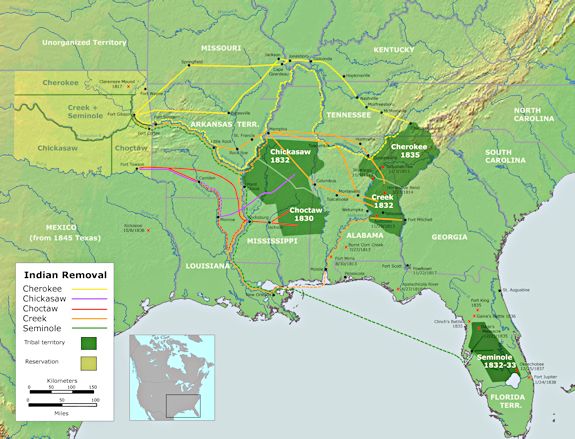
Trail of Tears Map

At the beginning of the 1830s, nearly 125,000 Native Americans lived on millions of acres of land in Georgia, Tennessee, Alabama, North Carolina and Florida–land their ancestors had occupied and cultivated for generations. By the end of the decade, very few natives remained anywhere in the southeastern United States.

Working on behalf of white settlers who wanted to grow cotton on the Indians’ land, the federal government forced them to leave their homelands and walk hundreds or even thousands of miles to a specially designated “Indian territory” across the Mississippi River (where Oklahoma is today). This difficult and sometimes deadly journey is known as the Trail of Tears.
Continue to Trail of Tears

American Indian Baskets

From ancient times to the present, Native Americans have created baskets. In fact, basket weaving is one of the oldest crafts developed by man.

Native American Indian baskets range from very simple to elaborate and colorful works of art that took great skill to make. This artwork often involves secret techniques that have been passed down from generation to generation among Native American Indian mothers and daughters.

It is not uncommon for a well-crafted basket to contain over one hundred thousand stitches! 
Continue to American Indian Baskets

Red Cloud’s War

Red Cloud's War, also referred to as the Bozeman War or the Powder River War, was an armed conflict between the Lakota, Northern Cheyenne, and Northern Arapaho on one side and the United States in Wyoming and Montana territories from 1866 to 1868. The war was fought over control of the western Powder River Country in present day north-central Wyoming. This grassland, rich in buffalo, was traditionally Crow Indian land, but the Lakota had recently taken control. The Crow tribe held the treaty right to the disputed area, according to the major agreement reached at Fort Laramie in 1851. All involved in "Red Cloud's War" were parties in that treaty.
Continue to Red Cloud’s War

The Colorado War

The Colorado War was an Indian War fought from 1863 to 1865 between the Cheyenne and Arapaho Nations and white settlers and militia in the Colorado Territory and adjacent regions.

The Kiowa and the Comanche played a minor role in actions that occurred in the southern part of the Territory along the Arkansas River, while the Sioux played a major role in actions that occurred along the South Platte River along the Great Platte River Road, the eastern portion of the Overland Trail.

The United States government and Colorado Territory authorities participated through the Colorado volunteers, a citizens militia while the United States Army played a minor role. The war was centered on the Colorado Eastern Plains.
Continue to The Colorado War