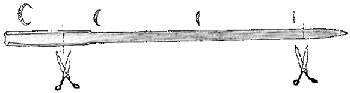
Native American bone chokers originally were made from bird legs. They were seldom used as just ornamentation. They were used as physical protection for the throat from a possible knife attack. The jugular vein is in the neck and is lethal if cut. They were also used in conjunction with physical protection as a spiritual protection for the voice. Because most birds are noted for the sounds they make or for their singing quality. The spirit of the bird could be invoked to protect the person’s voice from ailments, jealousy or fatigue.
Native American Crafts
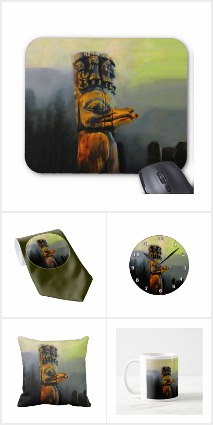
General Facts about Totem Poles
107 ViewsOn this page is a list interesting facts about totem poles including where the Indian tribes that made them were, why they sculpted totem poles, how they made them, and what materials they used.
American Indian Baskets
93 ViewsFrom ancient times to the present, Native Americans have created baskets. In fact, basket weaving is one of the oldest crafts developed by man.
Native American Indian baskets range from very simple to elaborate and colorful works of art that took great skill to make. This artwork often involves secret techniques that have been passed down from generation to generation among Native American Indian mothers and daughters.
It is not uncommon for a well-crafted basket to contain over one hundred thousand stitches!
The Shaman’s Rattle
109 ViewsThe shaman’s rattle is a most sacred instrument. The rattle is believed to embody the sacred forces of the cosmos through its sounds, structural features, contents, and connection to the spirit world. The gourd rattle is described as the sound of Creation. The creation stories tell of the first sound, a shimmering sound, which went out in all directions; this was the sound of “the Creator’s thoughts.”
Silver is 99.9% pure elemental silver. Sterling Silver is 92.5% silver and 7.5% other metals, usually copper. But what is coin silver, you ask? We are about to find out.
Silver jewelry can be created many ways. Pure silver is generally too soft for jewelry making, so it is combined (alloyed) with other metals. All the terms used to describe the various creation processes can be confusing. Here is a guide to sort it all out.
Mata Ortiz Casa Grande Pottery
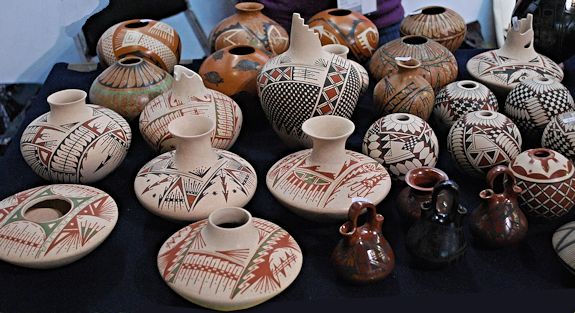
88 ViewsJuan Quezada was only a boy of 12 when he met his destiny to to bring the art world a style of pottery that had been lost for thousands of years. On journeys to the mountains to collect firewood, he became curious about the beautiful pottery shards he would find strewn on the ground at what is now known as the ancient Casa Grande ruins.
Beauty and Balance in Turquoise
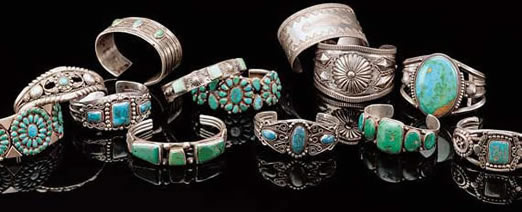
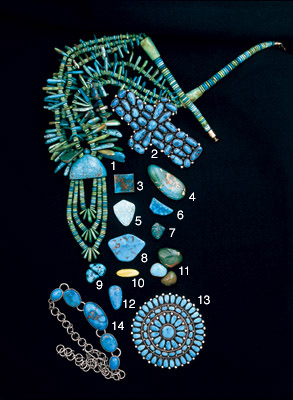
79 ViewsOne look at the elaborate turquoise bracelets, engraved silver belt buckles and ornate squash blossom necklaces featured in “Glittering World: Navajo Jewelry of the Yazzie Family,” and it’s clear that by bypassing accounting, Mr. Yazzie is giving the Navajo nation a much richer gift. The exhibition until early 2016 shows about 330 pieces of jewelry made by 15 members of the Yazzie family, with a focus on work by Lee and his younger brother Raymond.
Native American Talking Sticks
89 Views
![]() |
| Deer Jaw Talking Stick |
Talking sticks were used in tribal councils and public meetings to maintain order. Whoever had the stick had the floor, and no one else was allowed to speak until the speaker passed the stick, indicating he had finished what he wanted to stay.
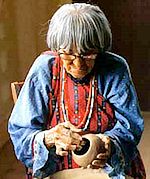
Maria Montoya Poveka Martinez (c 1881 to 1887-1980) is one of the native american pottery masters and probably the most famous of all pueblo potters. She and her husband, Julian, discovered in 1918 how to produce the now-famous black-on-black pottery, and they spent the remainder of their careers perfecting and producing it for museums and collectors worldwide.
Much of the vitality of contemporary native pottery stems from her inspiration and inovations.
The most popular jewelry styles from the Southwest are made by the Navajo, Hopi, Zuni and Santo Domingo tribes. While individual artists may make jewelry in a style usually associated with a particular tribe that may not be their own, these are the general, most common differences in the jewelry styles created by these Southwest tribes.
Indian Fetishes
84 ViewsIndian fetishes are Southwest tribal miniature carvings that some say are imbued with spirit forces.Fetishes are hand-carved objects, which represent the spirits of animals or the forces of nature. From the earliest times in North America, the Indians have used fetishes in an effort to master the arbitrary and unpredictable forces beyond their control. The earliest fetishes are called Ahlashiwe or stone ancients by the Zunis. They were naturally formed stones that seemed to resemble people or animals, sometimes made more realistic with the features accentuated by a carver.
Turquoise, the fallen Sky stone
68 ViewsTurquoise, the “fallen skystone”, “gem of the centuries”, is indigenous to the Americas, Egypt, ancient
Persia (Iran), Tibet and China. Throughout human history, the turquoise stone has been revered and admired for its beauty and reputed spiritual life-enhancing qualities. Native American Turquoise Jewelry is still extremely popular today.
Indian Trade Blankets
102 ViewsWhether woven by a Native American or mass-produced by American woolen mills on a Jacquard loom, the blanket is a constant of Native American life and it is inextricably tied to the tradition of trade in the Southwest. To this day, the rituals tied to blankets are part of Indian life from birth to death: […]
The Indian Trade Blanket
114 ViewsWhether woven by a Native American or mass-produced by American woolen mills on a Jacquard loom, the blanket is a constant of Native American life and it is inextricably tied to the tradition of trade in the Southwest.