A.I.M. founder, Dennis Banks dies of complications of pneumonia

Dennis Banks, native american activist

Dennis Banks, a founder of the American Indian Movement who helped lead demonstrations — notably the 10-week siege at Wounded Knee, S.D., in 1973 — that at times descended into violence as they brought long-festering tribal wounds to national attention, died Oct. 29 at a hospital in Rochester, Minn. He was 80.
Continue to A.I.M. founder, Dennis Banks dies of complications of pneumonia

November is Native American Heritage Month

A Native American man wearing traditional clothes and feathers dances inside a large room.

November is Native American Heritage Month! It’s time to celebrate the rich histories, diverse cultures and important contributions of our nation’s first people. Interior works to honor the nation’s trust responsibilities and special commitments to American Indians and Alaska Natives.

Check out how Interior supports Native American heritage and helps individuals and tribes strive towards a bright future.
Continue to November is Native American Heritage Month

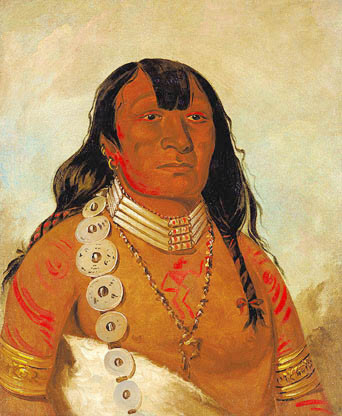
Dohasan, last Principal chief of the Kiowa

Kiowa chief Dohasan

Dohasan is the hereditary name of a line of chiefs of the Kiowa for nearly a century. It has been borne by at least four members of the family.

The first of whom there is remembrance was originally called Pá-do‛gâ′-i or Padó‛gå, ‘White-faced-buffalo-bull’, and this name was afterward changed to Dohá, or Doháte. He was a prominent chief.

His son was originally called Ä′anoñ′te (a word of doubtful etymology), and afterward took his father’s name of Doháte, which was changed to

Dohasan, Little Doháte, or Little-bluff, for distinction.

He became a great chief, ruling over the whole tribe from 1833 until his death on Cimarron River in 1866.
Continue to Dohasan, last Principal chief of the Kiowa

Abbigadasset, Abenaki sachem

Abbigadasset, Abenaki

Abbigadasset was an Abenaki sachem whose residence was on the coast of Maine near the mouth of Kennebec River. He conveyed tracts of land to Englishmen conjointly with Kennebis. In 1667 he deeded Swans Island to Humphrey Davy.  Continue to Abbigadasset,…

How many Apache sub-tribes were there and where were they located?

Apache Tribes Map

QUESTION:

How many Apache sub-tribes were there and where were they located?

~Submitted by Mindy D.

ANSWER:

The original homelands of the Apache Indians were in Arizona, Colorado, New Mexico, western Oklahoma, Western Texas, and Northern Mexico. The Jicarilla also ranged into what is now Kansas. The Apache tribe consists of six subtribes: the Western Apache, Chiricahua, Mescalero, Jicarilla, Lipan and Kiowa. Each subtribe is from a different geographial region.
Continue to How many Apache sub-tribes were there and where were they located?

What percentage Indian do you have to be in order to be a member of a Tribe or Indian Nation?

Question:

What percentage Indian do you have to be in order to be a member of a Tribe or Indian Nation?

~Submitted by Sonny S.

Answer:

Every tribe has its own membership criteria; some go on blood quantum, others on descent, but whatever the criteria for “percentage Indian” it is the tribe’s enrollment office that has final say on whether a person may be a member. Anyone can claim Indian heritage, but only the tribe can grant official membership.

Tribal Nations are the only recognized arbiter of belonging to or being a member of a tribe. No other agency or arm of any government has that responsibility, other than the particular tribe to which a person claims to belong.

Here is a list of some tribes that claim blood quantum / percentage Indian requirements:
Continue to What percentage Indian do you have to be in order to be a member of a Tribe or Indian Nation?